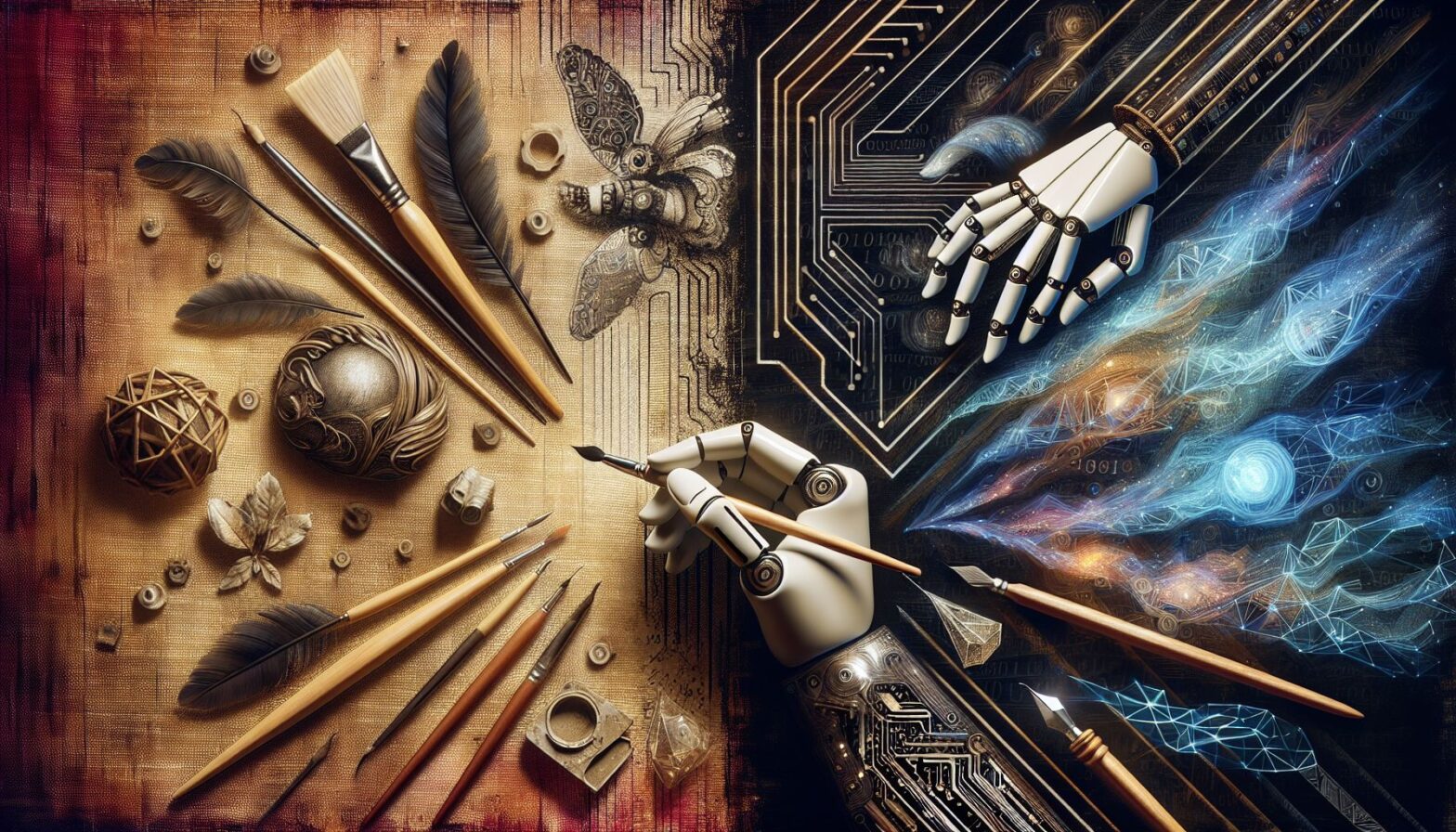
Breaking the Creativity Barrier: AI in the Arts

Introduction: My Mesh of Paint and Code

Before I get into AI in the creative arts, let me share a little about myself. I’ve always been a tech geek with an unusual love for oil painting. This dichotomy meant I spent nights going back and forth between canvas and code, two worlds that seemed completely separate. But what if art and science, brush and byte could actually work together? Thanks to AI, this line is blurring faster than we can say “Leonardo da Vinci”. We’re watching machines create symphonies, design interfaces, and even produce chart-topping hits. Call me a techno-utopian, but I think the creativity barrier was just waiting to be broken!

The Great Brush-off: How AI Went from Canvas Novice to Master Artist

Let’s rewind a bit. Remember when AI was just about algorithms playing tic-tac-toe? We’ve come a long way, folks! Flash forward to now, and AI, not happy with beating us at chess and Go, is becoming the Picasso of our time. Early versions might have drawn a potato that was supposed to be a cat, but today, OpenAI’s DALL-E and DeepArt are producing work that would make Dali proud.

What’s their secret? It’s all in the data and the models. Picture this: millions of artworks and styles compiled as training material. The AI goes to school with this data buffet, learning patterns, styles, and textures before creating its own masterpiece. It’s like sending your AI toddler to the best art school, but without the existential dread of student loans.

The results can be genuinely surprising. I’ve seen AI create portraits that capture emotion in ways I didn’t think were possible from an algorithm.

You Can’t Spell “Musician” Without AI (Kind of?)

Music was bound to get the AI treatment eventually. AI used to be just a sidekick to human composers. Now it’s jamming with the best of us. Take AIVA, for example. This algorithmic maestro composes orchestral pieces that blur the line between human and machine creation. Could Beethoven have used GPT-3 for writer’s block? Maybe.

Music production tools are becoming more accessible, so anyone from a 9-year-old novice to a garage band in Wisconsin can use AI to produce, publish, and even predict their next hit. If we’re not writing Grammy-winning pieces with AI coauthors in the next decade, I’ll eat my hat.

Though I have to admit, sometimes the AI-generated music feels a bit… cold. It’s technically impressive but misses something human. Other times it surprises me with unexpected emotional depth.

The Role of AI in Digital Design: Move Over, DaVinci

When the iPhone 12’s color scheme got critiqued like modern art, I knew the design world had changed forever. AI is now a co-designer, combining design principles and aesthetics, creating new worlds one pixel at a time. Adobe’s Sensei isn’t just a catchy name anymore. It’s a smart assistant (and real-time lifesaver) for designers everywhere.

If you’re a budding web designer, AI can help automate boring tasks, suggest design elements, and even predict user interactions without you having to burn the midnight oil. The combination of AI and creativity in design really works, bringing innovation without the mind-numbing repetition.

I’ve started using AI tools in my own design work. Sometimes they suggest things I never would have thought of. Other times they miss the mark completely.

Challenges: When AI Picks Up the Brush, Who Owns the Canvas?

Of course, any breakthrough brings challenges. We can’t ignore the million-dollar question: Who owns AI-generated art? Copyright issues are as thick as my grandmother’s cookies when it comes to figuring out who gets credit when an AI paints the next Monet. I think about this over my morning espresso daily.

And for every job that AI might help with, there’s anxiety, the classic “will the machines take over?” feeling. That’s a whole rabbit hole for another blog post, but for now, we’re looking at a collaboration model. Humans and AI working together, creating wonders as a team.

The legal stuff gets messy fast. If I use AI to generate a base image and then paint over it, who created what? These aren’t just philosophical questions anymore.

The Future: A Symphony of AI and Human Creativity

Looking into my digital crystal ball, I see a creative Renaissance powered by tech. The line between human and machine-made art will become more blurred, leaving only the quality and emotional impact of the piece as what matters. Robots won’t steal art from humans. Instead, they’ll provide endless tools for creation, like a cosmic paintbrush with a billion colors.

Imagine artists collaborating with AI in real-time to co-create living pieces: an evolving sculpture that adapts based on viewer emotions, music that adjusts its tempo based on listener mood, and interactive canvases that scream “engage!” rather than “just admire.”

I’m honestly excited about this future, even if it makes me a little nervous too.

Conclusion: My Ode to the Tech-Art Revolution

Whether it’s digital Van Goghs or symphonic compositions, AI in creative arts is changing these fields completely. It’s like watching a quiet revolution unfold as each brush stroke or musical note combines technology and art. So next time you enjoy a concept album or browse an online artist showcase, remember the invisible code behind it.

As we embrace this techno-creative new world, let’s paint outside the lines and dance to our own algorithm. Keep your brushes steady and your code alive. We’re just getting started.

Work your keyboards like I work my oils and let’s see what wonders we can create.

Unlocking the Secrets of Immortality: The Advancements in Longevity Technology

Hey, tech explorers! Today, we’re jumping into one of the most mind-bending fields that humanity’s ever dared to dream about: longevity and the quest for immortality. It sounds like sci-fi, right? But the progress we’re making in this space is as thrilling as it is real, part pharmaceutical, part digital, and yes, a little bit magical. Let’s explore the world of emerging longevity technologies and see how the future might look when 100 is the new 60.

Growing Beyond Age-old Myths

Long before technology touched our lives, humans were weaving stories about a fountain of youth or an elixir of life. Funny how myth turns into ambition, right? But here we are, in 2023, peeling back the layers of what it means to delay aging and extend quality life.

Science has moved beyond mythical potions. We’re working with concrete fields like genomics, biotechnology, and AI. Companies like Calico Labs (backed by Google) and Unity Biotechnology are closing in on what feels like nature’s most closely guarded secrets. With emerging technologies, we’re not just talking about extending lifespan. We’re aiming to extend healthspan. Who doesn’t want a few more decades of youthful energy?

The Genomic Revolution

At the heart of the longevity discussion is the genomic revolution. Remember when the Human Genome Project wrapped up and everyone thought, “This is it!” Well, it was more like, “This is just the beginning.” Fast forward a couple of decades, we’ve got CRISPR and powerful genome-editing tools reshaping our approach to aging.

Genomics is like coding life at a foundational level. Scientists are now identifying genes linked to longevity and learning how to tweak them. Take the recent experiments with the sirtuin family of proteins, involved in cellular resistance to stress. These are your genetic warriors, fighting the age battle at a cellular level.

But it’s not all science fiction yet. We’re still wrestling with ethical questions and unforeseen consequences. Imagine unlocking the code to aging, only to find out it messes with another biological system. Scientists are marching forward cautiously, asking not just if we can, but if we should.

Biohacking and DIY Longevity

Now let’s get a bit rebellious with biohacking. This movement’s got a certain tech startup vibe, doesn’t it? All the Silicon Valley types sipping their nut-milk lattes while injecting NMN or taking metformin to tinker with their metabolism. Biohacking is all about taking your body’s data and using it to micromanage your health down to the cell.

Of course, biohacking has its skeptics, and rightly so. The line between genius and madness can be thin when you’ve got folks treating their bodies like open-source platforms. Yet, the idea of testing our limits intrigues many in the tech community. Just remember: always vet those Reddit health tips multiple times before injecting yourself with anything!

AI and the Pursuit of the Elixir

You know everything’s getting a digital makeover when AI steps into the longevity scene. Artificial Intelligence isn’t just about amazing us with ChatGPT conversations. It’s digging through mountains of medical data faster than any human could dream of.

AI’s role here is to sift through medical records and research papers, identify patterns, and find potential treatments for age-related diseases. It’s like having a super-sleuth detective on your team, piecing together the complex puzzle of human aging.

Plus, AI’s predictive power in personalized medicine is incredible. Imagine getting a tailored health plan crafted from your unique genetic makeup, lifestyle, and microbiome. Sounds like an episode from “Black Mirror,” but it’s on the horizon.

Ethical Quandaries and the Societal Impacts

Before we barrel headlong into a utopia of living forever, let’s pump the brakes for a moment. Any paradigm-shifting tech brings its pack of ethical problems. If everyone’s living longer, what does that mean for population dynamics, economies, and inequality? And oh boy, what about pension plans?

While we’re all hyped about living symptom-free and active into our late years, longevity will inevitably be more accessible to those who can afford cutting-edge interventions. It’s challenging to ensure these breakthroughs don’t make societal divides worse.

And then there are the existential questions. Do we want to live forever? What would that mean for our perceptions of life and death? It’s a philosophical playground that bioethicists are starting to explore.

What Does the Future Hold?

Speculating about the future is a delightful dive down the rabbit hole. Picture a world where age is just a number, more people running marathons at 90 than folks half their age. Longevity could shift our professional paths, with four or five vibrant careers in one’s lifetime becoming the norm.

In search of immortality, the fusion of biotech and digital tech could redefine life as profoundly as electricity once did. Yet, as much as we’re enamored with tech and its promises, the human elements—emotion, connection, meaning—remain at the core of everything. After all, what good is adding years to your life if you forget to add life to your years?

So, join the conversation! Subscribe, share your thoughts, and let’s build our visions of bright futures, aging gracefully, but never being considered “old.”

The Great Leap: Transforming the Future with Quantum Computing

Welcome back, tech-savvy trailblazers! Today, we’re jumping into a realm that feels straight out of Isaac Asimov’s wildest dreams. We’re talking about Quantum Computing, and honestly, it’s getting harder to ignore the hype. Buckle up as we explore how this once-fringe concept is starting to flex its muscles and potentially redefine, well, almost everything. This isn’t just another tech trend. It’s a complete paradigm shift.

Quantum Computing: What’s All the Buzz About?

You’ve probably heard people throwing around “quantum computing” like it’s the next sliced bread. Everyone says it’s going to change everything from cryptography to drug discovery. But what actually is a quantum computer, and why should you care? Let me break it down for you.

Quantum computing taps into the weird, mind-bending principles of quantum mechanics. You know, the stuff that governs how particles behave at subatomic levels. While our regular computers use bits that are either zeros or ones, quantum computers use qubits. These little powerhouses can represent and store way more data because they exist in multiple states at once (thanks to something called superposition).

Here’s why this matters: superposition and entanglement give quantum computers the ability to solve certain problems exponentially faster than our current machines. We’re talking about computational power that could tackle problems we’ve only dreamed of solving. Pretty wild, right?

Where Quantum Computing Is Making Waves

Let’s walk through some areas where quantum computing is starting to shake things up.

1. Drug Discovery Gets a Quantum Boost

Picture this: designing a drug on a computer before you even touch a test tube. Quantum computing is making this possible by modeling molecular interactions with incredible precision. This could slash the years and billions typically needed for drug development. Alán Aspuru-Guzik’s team at Harvard’s Clean Energy Project is already using quantum computing to speed up organic solar cell development. The results are promising.

2. Financial Forecasting Beyond Traditional Models

The finance world is getting a quantum makeover. Complex financial modeling and massive portfolio analysis become manageable tasks with quantum systems. This is particularly exciting for risk management and fraud detection. Banks and investment firms are paying attention because the competitive advantage could be massive.

3. Quantum-Enhanced Security

Digital security has never been more important than it is today. Quantum computing offers ultra-secure encryption methods that laugh in the face of traditional computer attacks. Quantum key distribution (QKD) could bring us essentially unbreakable encryption. Good news for us, terrible news for cybercriminals.

4. AI Gets a Quantum Upgrade

Quantum computers can handle machine learning tasks with impressive efficiency. They run quantum versions of neural networks, dramatically improving training times and accuracy. Google’s Sycamore quantum supremacy experiment and IBM’s Quantum Hummingbird give us a peek into a future of smarter, faster AI systems.

The Players Pushing Quantum Forward

The quantum space is packed with researchers, labs, and companies betting big on this technology. Here are the ones making the biggest splash:

The Big Names in Quantum

  • IBM Quantum: Their Q System One is opening quantum computing access to enterprises and research institutions. It’s like quantum computing as a service, and it’s working.

  • Google Quantum AI: Google hit a major milestone with Sycamore, their 54-qubit processor that performed a task in 200 seconds that would take a supercomputer 10,000 years. That’s the kind of performance gap that gets people excited.

  • D-Wave Systems: They specialize in commercial quantum computing solutions for complex optimization problems through quantum annealing. Less flashy than some competitors, but they’re solving real business problems.

Global Quantum Initiatives

It’s encouraging to see international collaboration on this front. The EU’s Quantum Technology Flagship and the U.S. National Quantum Initiative are pooling talent and resources to make quantum computing mainstream. Competition drives innovation, but collaboration accelerates it.

The Reality Check: Quantum Computing’s Growing Pains

Before we get too carried away, let’s talk about the elephant in the room. Quantum computing still faces some serious challenges:

The Noise Problem

Quantum computers are incredibly sensitive to environmental interference, which causes something called decoherence. Imagine trying to have a phone conversation during a thunderstorm. Quantum error correction is improving, but we’re not there yet.

Scaling Up Is Hard

Most practical applications need thousands of qubits working together perfectly. Getting that many qubits to play nice is incredibly difficult. It’s like conducting an orchestra where every musician is blindfolded and wearing noise-canceling headphones.

Building the Things

Creating stable, high-quality qubits requires exotic materials and manufacturing techniques that push current technology to its limits. It’s expensive and complicated.

What’s Next for Quantum Computing?

Despite the challenges, quantum computing isn’t going anywhere. The potential is too big to ignore. Researchers are making steady progress on error correction, scalability, and manufacturing. We might not have quantum computers in every home anytime soon, but specialized applications are already showing real promise.

Richard Feynman once said: “Nature isn’t classical… If you want to make a simulation of nature… you’d better make it quantum mechanical.” He was right, and we’re finally building the tools to prove it.

I think we’re standing at the edge of something big here. Maybe not as earth-shattering as some headlines suggest, but significant enough to change how we approach computing in fundamental ways.

What do you think? Are we really on the verge of a quantum revolution, or is this just really sophisticated hype? I’d love to hear your thoughts in the comments below!